Author Archives: Nooresunnat

Special Instructions for Ramadan – How to Attain the True Blessings of Fasting

Source: Lectures of Hazrat Maulana Shah Abrar Ul Haq Sahab R.A – Khalifa Hazrat Maulana Ashraf Ali Thanvi R.A (Majlis e Dawat ul Haq, Hardoee, India)

Things to do in Ramadan

1) Frequent recitation of Kalima e Tayyiba

2) Excessive Istaghfaar

3) Supplications for Jannah

4) Asking for protection from Hell

5) Excessive recitation of the Holy Quran. Also, excessive recitation of Durood Sharif, if possible at least  300 times or as many times as possible.

6) Offering Fardh Salah with congregation and Takbir e Ula

7) Going early for Isha Salah and Taraweeh (20 Rakaat)

8 ) Spending free time in the mosque with the intention of Etikaaf.

9) Spending on charity, as much as possible conveniently.

10)  Strictly guarding the tongue from any useless talk. Avoid any unnecessary worldly talks.

11) Strictly abstaining from all sins specially watching TV, movies/cinema, back biting, listening to music, unnecessary use of the internet, mixed gatherings of na mehram men and women, women not practicing the veil, using foul language and swearing, shaving or trimming of beard to less than one fist length and other such sins should be very strictly avoided otherwise such a Roza / Saum would not hold any value before Allah(SWT). It is narrated in Hadith:

“Fasting is a shield against Hell unless one breaks it. Breaking it means committing sins” (Mishkat Sharif)

Note: We need to understand that during fasting, we even abstain from basic necessities such as food and water. Cigarette and other types of addictions which are usually hard to leave are also thrown away during fasting only in compliance with the commands of Allah(SWT) and in order to gain the blessings of fasting. How foolish then it would be to ruin our fasts by committing sins and other unlawful acts.

It is narrated in Ahadith that those who do not abstain from unlawful and sinful acts during fasting, Allah(SWT) does not care for their mere starving. Allah(SWT) helps those who strive in his path. A person who was a smoker for the last 20 years left it when he heard that it is extremely shameful to pollute the same tongue and mouth which we use to recite the Holy Quran and Durood Sharif. He just made intention and Allah(SWT) helped him. Another person, during my stay in London, immediately quit smoking when he heard the same thing. Masha Allah both of them have been steadfast in their intentions and Allah(SWT) has helped them.

Similarly, in this blessed month:

1) Keeping Sunnah Beard

One should make the intention to keep Sunnah Beard (which is wajib) up to one fist in length. Afterwards, look at yourself in the mirror and decide for yourself. Insha Allah you would realize that your face would be glowing with the noor of Sunnah. This is such a grave sin that the person who commits it is regarded as a continuous sinner. If somebody commits adultery, theft or murder in the darkness of night, nobody would know it in the morning. But by shaving off the beard, one can be identified as a sinner even during prayers, hajj and is deprived off the blessings of Allah(SWT).

Many people keep their beard up to one fist in length from the front, but trim it off from the sides on the cheeks. That is totally incorrect. It is mandatory (wajib) to keep beard up to one fist in length from the front as well as from both the sides.

2) Observing Hijaab / Veil / Pardah

Men and Women should observe Sharaee Pardah from all strange (na mehram) Women and Men respectively. (for details refer to Bahishti Zewar by Hazrat Maulana Ashraf Ali Thanvi R.A). Over here, only those na mehram relatives are being mentioned who are usually not considered as ne mehram even by many religious families.

Na Mehram Women For Men:

  • Brother’s Wife
  • Wife’s Sister
  • Female Cousins
  • Aunties (excluding sisters of parents)

Na Mehram Men For Women:

  • Sister’s Husband
  • Husband’s Brother
  • Male Cousins
  • Uncles (excluding brothers of parents)

3) Abstaining from Back Biting / Gheebat

Make special effort to abstain from Back Biting as it kills the spirit of Fasting.

4) Protecting Gaze (for both Men and Women)

Gaze should also be strictly guarded from strange (Na Mehram) Men and Women as it is one of the “Poisonous Arrows” of Iblees which deprives one of the blessings of prayers and worship.

May Allah(SWT) help us in acting upon these points.

The Difference between Giving Up Sin and Being Made to Give Up Sin

The Difference between Giving Up Sin and Being Made to Give Up Sin

Your corpse will not be able to cast lustful glances but that will not warrant one any reward from Allah Ta’ala, for the sacrifice of a corpse is not acceptable in His court. Allah Ta’ala wants us to become His, to sacrifice our desires, whims and fancies while hale and hearty,while still alive and able to commit those sins. Why are you waiting forthat time when death will reap your soul and you will be unable todisobey Allah? This will be termed, ‘being made to give up sins’ andnot ‘giving up sins’. Voluntarily giving up sins while the choice to commit them still exists within one will entail a lofty stage offriendship with Allah Ta’ala. Bear the burden of leaving sins. If onedesires to enjoy the pleasure of Allah’s pleasure, bear the burden andexperience that pleasure wherein the burden itself will no longer remain a burden.

Source: Patience and the Status of Siddiqueen (English) (Urdu)

Discourse: Aarif Billah Hazrat Maulana Shah Hakeem Muhammad Akhtar Sahab Db

Surah Fatiha

Tafseer of Surah Fatiha – Mufti Taqi Usmani Sahab Db

In January 2008, Hazrat Maulana Mufti Muhammad Taqi Usmani Sahab Db started doing the Tafseer of the Surahs of Quran which are usually read in prayers by common muslims.

He started by doing the Tafseer of Surah Fatiha. The Surah Fatiha Tafseer went on for 13 weeks and Alhamdulillah it was extremely beneficial and cleared many misconceptions that common muslims usually have in mind.

I would highly recommend everyone to listen to these Tafseer Lectures of Surah Fatiha and also share them with your contacts.

For detailed Tafseer, The Noble Quran by Hazrat Mufti Taqi Usmani Sahab Db would be ideal for English speaking users.

Tafseer Surah Fatiha by
Hazrat Mufti Muhammad Taqi Usmani Sahab Db

Tafseer Surah Fatiha – 1 (Allah Tamaam Aalamo Ka Rab Hai) Tafseer Surah Fatiha – 8 (Allah Tak Pohanchnay Ka Nuskha)
Tafseer Surah Fatiha – 2 (Allah Ki Bohat Wasee Aur Mukammal Hai) Tafseer Surah Fatiha – 9 (Allah Hi Ibaadat Kay Laiq Hai)
Tafseer Surah Fatiha – 3 (Allah Roz e Jaza Ka Maalik Hai) Tafseer Surah Fatiha – 10 (Aqeeda e Toheed Aur Shirk Ka Gunah)
Tafseer Surah Fatiha – 4 (Qayamat Kay Din Ki Tayyari) Tafseer Surah Fatiha – 11 (Allah Se Seedha Raasta Maango)
Tafseer Surah Fatiha – 5 (Fikr e Akhirat Aur Aqeeda e Aakhirat) Tafseer Surah Fatiha – 12 (Har Haal Main Allah Ko Pukaro)
Tafseer Surah Fatiha – 6 Aur Namoos e Risaalat Tafseer Surah Fatiha – 13
Tafseer Surah Fatiha – 7 (Hum Allah Hi Se Madad Mangte Hain)
Also Listen to the Recitation of Surah Fatiha

Suarh Fatiha Tilawat – 1

Surah Fatiha Tilawat – 2


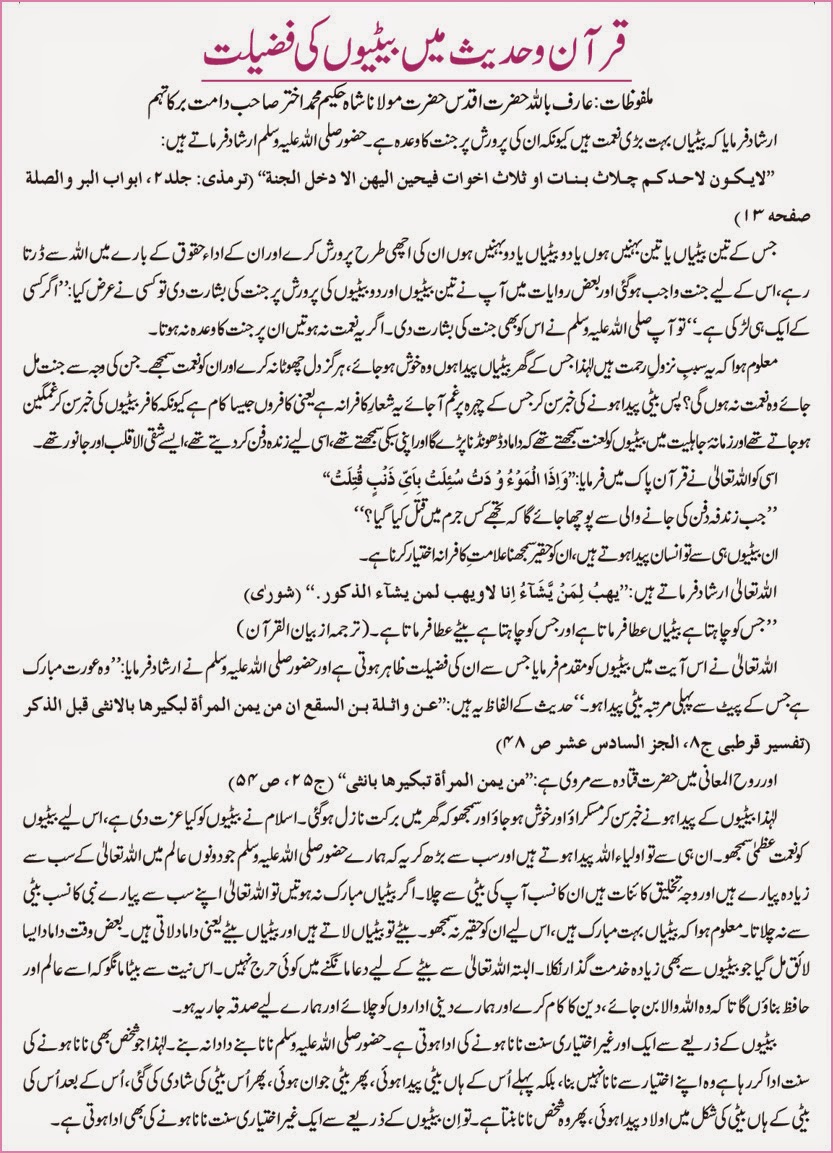
The Blessings of Daughters in Islam – from Quran o Hadith

Listen to the Audio Bayan

Beti Allah Ki Azeem Naimat, Uski Tarbiyat Kay Fazail Aur Hamari Kotahiya

Speaker: Hazrat Maulana Mehboob Elahi Sahab Db (Khalifa e Majaz, Arif Billah Hazrat Maulana Shah Hakeem Muhammad Akhtar Sahab Db)

Daughters in Islam Women in islam

The Blessings of Daughters from Quran o Hadith

(Summary of the article above)
Taken from various lectures of Aarif Billah Hazrat e Aqdas Maulana Shah Hakeem Muhammad Akhtar Sahab Db

Daughters are a great blessing because Allah(SWT) has promised a place in paradise (Jannah) on bringing them up. The one who has 3 daughters or sisters, or 2 daughters or sisters and he brings them up properly and fears Allah(SWT) regarding their rights, then Paradise is made mandatory for him. In some Ahadith, when the Prophet(SAW) mentioned the blessings of bringing up 3 daughters or sisters, somebody asked “What if someone has only 1 daughter?” The Prophet(SAW) mentioned the same prize for him as well,i-e a place in the paradise. Paradise would never be made mandatory for such people had daughters not been blessings of Allah(SWT).

This shows that daughters are indeed a source of blessing from Allah(SWT), therefore if a daughter is born in someone’s house, he should not be saddened by this, instead he should rejoice and thank Allah(SWT) for this blessing. How can they be inferior when a place in paradise is being promise against them? Getting saddened by the birth of daughters was the practice of the Non-Believers(Kuffar) because before the Prophet(SAW) came, the Kuffar used to get saddened by the birth of daughters and used to consider them a burden as they would need to find someone for their daughters to marry. They were such animals that they used to bury their innocent daughters alive.

It is these blessed daughters that are the means for the existence of humanity, how can they be considered a curse, this is the act of the Non Believers. The Prophet(SAW) has called her a blessed woman who’s first child is a daughter. Therefore rejoice and smile when you hear about the birth of daughters and consider them a blessing for yourself.

Islam has given a very high status to daughters, therefore consider them a huge blessing of Allah(SWT). It is these daughters through whom Saints (Auliya Allah) are born and above all, our beloved Prophet(SAW), for whom this world was created, his family and bloodline was continued through his daughter. If daughters were not a blessing then Allah(SWT) would never choose them to carry forward the bloodline of his most beloved Prophet(SAW). This shows that daughters are indeed a great blessing so do not consider them inferior. Sons bring Daughters in Law and Daughters bring Son in Law. Sometimes the son in law is so obedient that he surpasses daughters in serving his parents in law.

However, making dua for Sons is not forbidden, one may do that. Ask Allah(SWT) for sons with the intention that you would make them Aalim, Hafiz so that they would take care of our Religious Institutions (Madaris) and hence become a Sadqa e Jaariya for us.